Design for Supportability Report
 Dr. Frederick C. Van Bennekom and Dr. Keith Goffin authored Problem Prevention Through Design for Supportability: Gaining Competitive Advantage from Customer Support (published in 2002 by the Customer Service Press) to help firms understand the impact that product design can have throughout the life cycle of the product, especially during the customer experience stage where much of the life cycle costs occur. This extensive 100-page research study addresses root cause problem prevention through better design practices in both hardware and software products.
The report incorporates research performed by the authors with dozens of company examples and the tools needed to become a change agent in your organization and start your DFS initiative.
What is Design for Supportability? How does it differ from Design for Serviceability?
The product design process is a key area in which a company can develop competitive advantage. Years ago product designers’ only concern was to design features and performances into products. Then concurrent engineering practices led to design for manufacturability as a driving criteria of a good product design. Various other “design for-____” have been promulgated in recent years. Most, though, have focused on the impact of product design upon the downstream activities within the company. Design for Servicability tends to also have this inside focus — cutting servicing costs.
Design for Supportability looks beyond the company’s doors. DFS is the process of maximizing the benefits the customer receives during the product ownership period. In today’s lingo, it is truly designing the product for optimal customer experience. Any comprehensive customer experience management program must have design for supportability as one of its core programs.
Further, supportability is more than serviceability, maintainability, usability, durability, or reliability. We define DFS as encompassing the entire range of events in product ownership from installation, to use, maintenance, enhancement, and finally decommissioning. Design for Supportability is the umbrella under which design for usability, design for serviceability, design for maintainability, and design for reliability all fall.
With strong Design for Supportability practices, an organization delivers products to its customers with a lower Total Cost of Ownership (TCO) and higher Total Value of Ownership — also known as Total Net Benefit of Ownership. Concurrently, the cost to deliver the product and support services will be lowered.
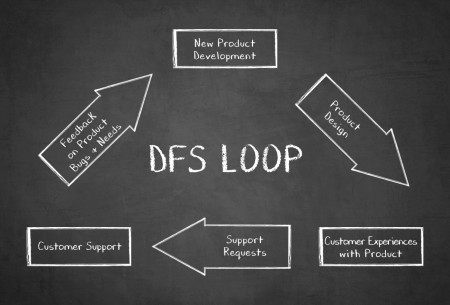
At its heart, DFS is about problem prevention, not problem resolution. Once the product is in the customer’s hands, many companies practice an “out of sight, out of mind” philosophy. True, most companies have a response center to answer customer questions, and they recognize that good after-sale support impacts customer satisfaction. However, the common practice is to charter the support organization primarily with an efficiency goal: resolve the customer’s problems as fast and cheaply as possible. Support organizations may engage in some preventive maintenance and talk about moving from reactive to proactive support practices. DFS is the ultimate proactive or preventative support practice because it addresses the true root cause of most support problems: the design of the product. A DFS initiative operates from that vantage point.
Supportability doesn’t happen by accident. It must be an explicit concern at the design stages of a product. Without a comprehensive approach with explicit goals, some areas of supportability may improve but other areas may actually worsen. The organization best suited to make the supportability argument is the customer support organization. Yet, in most cases, the support organization lacks the political strength to advance the argument. DFS recognizes the strategic role that customer support can play in companies.
A growing number of companies are practicing some “out of the box” thinking. These companies recognize that good customer support can create satisfied customers, but that a product designed for superb supportability can engender true customer loyalty. Customers want peace of mind. They want a product that will provide its intended benefits, complemented with high quality but minimal support requirements, thus assuring a superior total cost of product ownership. With this product strategy, the cost for a customer to switch to a competitor is high due to the risk of an inferior experience from the unknown vendor.
Achieving DFS is not simple. There are many barriers to this change management process, and the primary one is cultural. Customer support is seldom viewed as a strategic partner within companies. The goal of this research report is to present a comprehensive framework for a DFS program in all its elements and to map out the process that a company can pursue to increase product supportability.
We are now offering the report as a PDF electronic fil for $95.00. This PDF version can be shared among your whole team — with just one purchase.
To order, please use our online order form and we’ll contact you to arrange for payment or contact us.
Product information: 98 pages, 8.5″ x 11″.
Chapter 1: The Strategic Potential of Customer Support
Chapter 2: Competitive Advantage and the Customer Product Use Cycle
Chapter 3: Design for Supportability
Chapter 4: Characteristics of a DFS-Empowered Customer Support Organization
Chapter 5: Developing an Action Plan